


By Fatmouth Sports Network Staff
The Florida A&M University Rattlers are no strangers to adversity. From the gridiron to the boardroom, the “Excellence with Caring” mantra has carried this institution through challenges that would have felled lesser programs. But a new opponent has emerged, and it’s not lining up across the line of scrimmage. It’s a crisis of confidence, and it’s manifesting in a very real way: the silence of the checkbooks.
Alumni giving at FAMU is facing a storm. While the university has celebrated moments of success in fundraising, a deep-seated reluctance is growing among the alumni base. The message from the Rattler faithful is becoming impossible to ignore: “Show us the plan, or we’re keeping our money.”
A Feared Trend Becomes Reality
For years, the narrative surrounding FAMU has been one of potential untapped. The alumni donation rate has historically languished in the single digits, a point of frustration for administrators and a point of shame for the community . However, recent years saw a surge. Giving was on an upward trend, climbing to an impressive estimated $27 million in the 2023-24 fiscal year .
That momentum has screeched to a halt. According to university officials and finance charts, donations plummeted to about $17 million the following year. This year, the university is down $1.1 million compared to where they were at this point last year . As of December 2025, FAMU had raised $6 million compared to $7.1 million the previous year .
This isn’t just an economic slump; it’s a protest. As former ABC News President and distinguished FAMU alumna Kimberly Godwin bluntly stated during a Board of Trustees meeting, “Donations are way down, and alumni are disenfranchised and upset” .
The “OneFAMU” Fumble
At the heart of the current strife is a lack of transparency. An ambitious initiative known as “OneFAMU” was introduced to consolidate the university’s four Direct Support Organizations (DSOs)—the Foundation, National Alumni Association, Research Foundation, and Rattler Boosters—under a “coordinated banner” .
The idea was to project unity. Instead, it has sparked a mutiny. The president of the Rattler Boosters, Zachary B. Ansley, penned a blistering internal letter obtained by Rattler Nation, accusing the university of running a “top down directive” that contradicted the initiative’s very name .
Ansley highlighted a significant failure: the process was presented as a mandate, not a collaboration. “We develop concepts of programs together, foster initiatives together, set implementation timelines together, vet companies together,” Ansley wrote, outlining his vision of true partnership. The current approach, however, was painfully short of that ideal .
When a major consulting initiative is presented as a “done deal” before the people writing the checks are even brought to the table, trust evaporates. This “top down” approach, as seen in the “OneFAMU” rollout, signals a disregard for the volunteer leaders who are the custodians of FAMU’s legacy.
The “ALL IN” Campaign: A Step Forward?


Even new Head Coach Quinn Gray has felt the strain of rebuilding trust. His “Restore the Strike” campaign and the famous “ALL IN” challenge to alumni and celebrity fans highlights the pivot the university is trying to make .
The “Restore the Strike” campaign has seen early success—raising nearly $170,000 out of a $250,000 goal—largely due to high-profile asks and a clear, specific list of needs (nutrition, practice field lights, fieldhouse upgrades) . As Marvin Green Jr., FAMU’s Major Gift Officer, noted, the goal is to convert supporters into stakeholders “Stakeholders dictate the type of outcomes you have” .
However, the fact that Gray—a beloved alumnus—has to publicly tag wealthy fans like Will Packer to get them on board tells you everything you need to know about the state of the relationship.
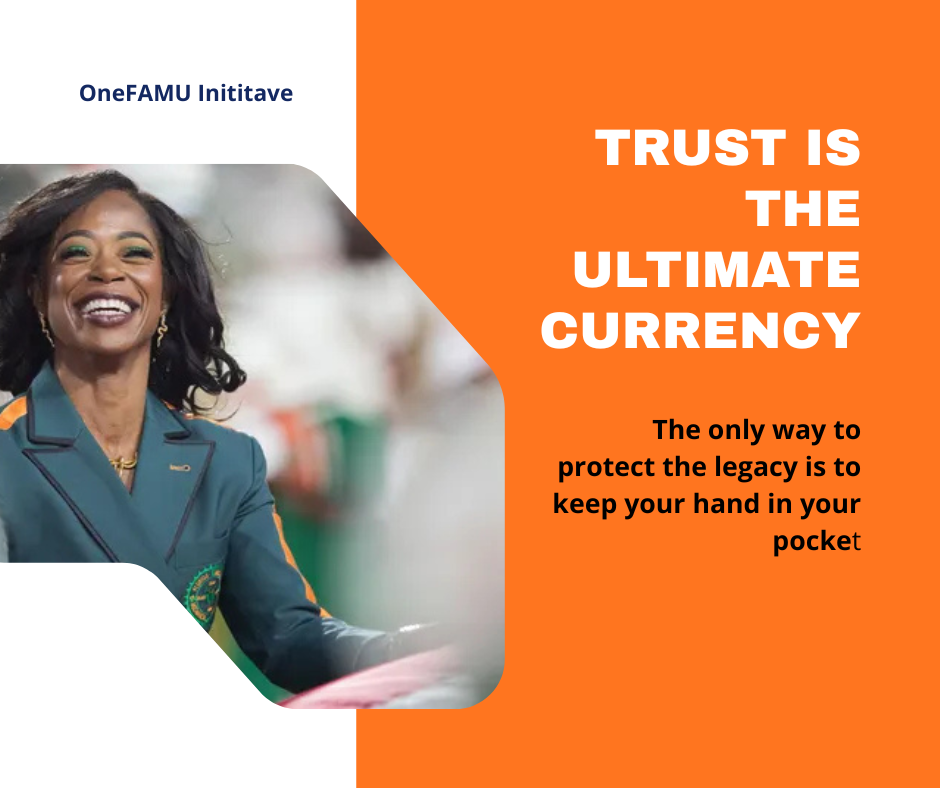
Trust is the Ultimate Currency
The friction extends to the top. The appointment of President Marva Johnson, which came amid allegations of a compromised search process and the removal of dissenting board members, has been a lightning rod for donor anger . As Chekesha Kidd, a consultant and Foundation board member, pointedly noted, Johnson was hired for her relationships. Now it’s “time for her to deliver on those” .
Alumni are not just reluctant; in some cases, they are downright angry. They are asking a simple question: “How are you using my money, and what is the vision?”
It seems the administration is finally getting the message. Acting Vice President Brandi Tatum-Fedrick has admitted that while donor engagement is increasing, the gap in giving is driven by a “recalibration” in corporate and foundation giving and a broader donor base giving smaller amounts .
But a recalibration is a diplomatic word for a rupture. For FAMU to reclaim its place as the pinnacle of public HBCUs, it needs to heal that rupture. That requires transparency. It requires inclusion. It requires the university to treat its alumni not as ATMs, but as partners in the mission. Because on the Highest of Seven Hills, a faithful Rattler knows that if you aren’t sure where the money is going, the only way to protect the legacy is to keep your hand in your pocket.


